• In Defense of Crossdressers: Bryon Noem’s Kink Isn’t The Problem (A Trans Woman’s Perspective)

    In Defense of Crossdressers: Bryon Noem’s Kink Isn’t The Problem (A Trans Woman’s Perspective)

    Recently, I’ve made a few posts about Bryan Noem’s recent controversy, where it was revealed that he was paying sex workers a pretty penny to engage in his bimbofication crossdressing fetish. To many people, this seemed like a contradiction, but as a trans woman and former sex worker, it was pretty predictable. Through my life, I’ve known many men like him, and in my videos, and in this post and others, I’ve openly discussed my interactions with conservative men who crossdress and the way that misogyny often intersects with their fetish and their bigotry. To many people, these things feel like a contradiction, but to me, it feels like a continuation of the same thread. Oftentimes, I’ve come online to speak about an underground that many people seem unaware of: the commonality of crossdressing among men who identify as heterosexual and conservative. However, I’m not always great at reiterating certain points about crossdressing, which is largely why I’m making this post.

    I have occasionally been accused of being bigoted towards crossdressers, and I will admit that I do indeed have a bit of a bias. Crossdressing on its own is rather inoffensive to me. Many of the men who do it just want to find a space for them to do so freely. I have been a BDSM community organizer in the Los Angeles area for many years now. I’ve known many crossdressers and called many my friends. Not all crossdressers live in shame or get a sexual kick from the idea of degrading themselves through feminine dress.

    Crossdressing has many nuances for those who consider wearing women’s clothing “cross-dressing.” The term itself can be rather controversial. How does one crossdress if clothing isn’t gendered? For those of us who are less invested in the gender binary, the idea of crossdressing may be offensive on its face. However, for all of the queer theory debate we have around the use of these terms, “crossdressing” is still the term many men will use when they have a special interest in wearing women’s clothing, as a man. Crossdressing isn’t something I’m personally interested in, but I’m also not personally interested in pet play or tickling. That doesn’t mean the people who engage in those things are uniquely bad, and I don’t want to really give people the impression that this is how I feel. Many men enjoy crossdressing and, frankly, that is something I don’t have any emotions about. Where something like race play, for me, has a particularly universally upsetting impact on me, crossdressing doesn’t remotely inspire the same emotions within me. That said, my bias comes from the fact that being a black trans woman navigating the online dating space within mostly white conservative towns has put me in direct contact with many men like Bryan Noem. Men who are deeply conservative, deeply bigoted, often anti-black, and almost explicitly getting off on being dishonest. Men who are deeply steeped in misogyny.

    Society is very wrapped up in the idea of policing gender, and that is sometimes twisted into a kink by the people who have the most to benefit from that policing. When you look at Bryan and Kristi Noem, they have an idyllic family. They’ve been married for 34 years and have three children together. They even had a dog at some point, but… never mind that. They’re Evangelical Christians attending the Foursquare Family Worship Center, which outlines its attitudes towards the LGBT community here. Those familiar with Kristi Noem’s politics will be unsurprised by the church’s ideology’s bigotry. Former DHS leader, Kristi Noem, has been an outspoken opponent of gender affirming care and has signed quite a few pieces of legislation limiting the rights and freedoms of transgender individuals. So when it was revealed that her husband had a crossdressing kink, many people called Bryon Noem a hypocrite. The point being, of course, that Bryon Noem may have something in common with a transgender woman.

    There has been a lot of discourse about whether or not Bryon Noem is transgender, but here’s what we know:

    Bryon Noem contacted several sex workers under a false name, looking for bimbofication services. Bimbofication is essentially a type of roleplay where a person is turned into a hyperfeminine, hypersexualized version of themselves. Roleplay is often escapism. It’s you retreating into a role that may not exactly reflect your daily life, but may give you a sense of relief. Like most of BDSM, it’s meant to be play and not taken seriously. For many, it is an escape. Men like Bryon Noem enjoy the idea of a woman feminizing them because that is so unlike most of their lives, where they are distinctly the ones giving orders and defining what’s what. Ask any sex worker, and they’ll tell you that sometimes the men who want this the most are the men whom society would deem as successful. For a powerful CEO, going to a glamorous woman, who can make him into a glamorous woman, is like a brief vacation from the reality of their life.

    Quite often, this kink is empowering, and it’s not terribly uncommon for men to go to a Domme for an experience or service like this. And yes, for some of them, this is how their egg cracks and some of them may very well recognize that they aren’t cis men at all. Crossdressing is often many men’s first foray into gender exploration. There is a bit of a correlation between this and many of these men being in more conservative communities, where they could probably never be out and gainfully employed. In fact, for some crossdressers, similar to trans women, they may desire the relative safety that comes with being read as a cis woman, as opposed to a trans woman when they are out in public. It’s not terribly uncommon for crossdressers to advise each other on looking more “convincing”. This isn’t always sexual; in fact, it often isn’t at all. For many pre-transition trans women, crossdressing fetish culture may allow them to be, at least temporarily, who they really want to be. In Los Angeles, there are several sex parties for crossdressers and trans women, and from my observation, these events often serve as a space for many of them to socialize, build community, and make friends. Sure, there may be a sexual element, but some people will come to those parties because it’s the only place they’re able to “dress”. For years, Hamburger Mary’s in Long Beach has been a haven not just for trans women and drag performers, but also crossdressers who often just wanted a night out on the town with other crossdressers. In my youth, speaking to some of these CDs, I got the sense that while some of them would be transgender if the circumstances were different, many of them simply enjoyed being men who wore women’s clothing, even if they would have made very beautiful trans women. Many of the crossdressers I’ve known have been objectively gorgeous, and even the ones who aren’t are still often kind and well-meaning. However, there is certainly a large percentage of crossdressers who are like Bryan Noem, conservative and patriarchal men who were often crossdressing behind their wives’ backs.

    I think crossdressing on its own is pretty neutral, but it becomes pretty hard to ignore the trend of misogyny and bigotry among many crossdressers. The baseline of this is that many crossdressers will explicitly get off on hiding their habit from their wives, and they will often include articles of their clothing in their kink without their consent. You easily get the impression from these crossdressers that they feel a sense of ownership over their wives that is quite misogynistic. Oftentimes, they will degrade them in their online posts and criticize their femininity. When I’d talk to some of these crossdressers at various events, you can tell that part of the thrill for them is sneaking away wearing the clothing of their unaware partner and feeling degraded for being feminine. From what I’ve gathered, for some of the trans women who find themselves through crossdressing, this shame element will often shift as they dress more and more. Eventually, it becomes an empowering externalization of their particular unique interest in feminine clothing. However, there’s an element of shame that is ever-present among misogynistic crossdressers. A shame that is closely related to how they view women.

    I think it’s hard for most people to accept that most men who crossdress aren’t gay men, but straight men. We’re used to thinking of crossdressing in the realm of drag, where at least a large portion of drag performers are indeed gay men. But Drag is a performance art, whereas crossdressing is closer to a hobby, which becomes a fetish for some. Most men who crossdress actually do it because of their attraction to women, and often it’s an externalization of how they’ve processed that attraction. It’s one that’s often informed by the male gaze, and in conversation with misogynistic cross-dressers, you will often hear an anti-feminist slant.

    Many of the misogynistic, conservative men I’ve known who crossdress have a particular fixation on how women have become less feminine as they’ve gained more rights. These men are often married, and they have particular ideas about how their wives have let themselves go and allowed time, children, and worst of all, their work, to get in the way of performing their feminine duties. Knowing that, I unfortunately started to think about Kristi Noem and how her face has changed over the years. It would not shock me if he had some part in that. These men often want their wives to be surgically enhanced, and they want them to maintain a high-femme image that’s meant to complement their curated masculinity. For some of these men, it’s clear that their crossdressing is, in some way, a cultivation of what they personally find attractive, and they will occasionally imagine themselves to be better at performing feminine gender expression than cis women. While I disagree with the concept of Autogynephelia, I think this is the closest we really get to seeing this. There is actually quite a large culture of straight men who crossdress and create intricate photoshoots often styled as their favorite porn models, and usually for an audience of other crossdressers who enjoy doing the same. And frankly, there’s really nothing wrong with that. Who cares if men get dressed as women and it turns those men on? It’s something I have a hard time caring about. The line, however, that I will draw is when this conflation is made about me, as a trans woman.

    I think what makes most of these conversations complicated is the fact that most people will literally never be privy to the interactions someone like me has with these men, but they are often quite bigoted towards trans women, especially black trans women. My main interaction with the Bryan Noem type comes from a time in my life where I lived in more conservative communities, where gender performance was on a whole new level. What I’d experience as a trans woman who is very open about only being attracted to men and explicitly being interested in masculinity is that time and time again, I’d connect with a guy who presented himself as a paragon of masculinity, only for him to reveal to me at a certain point that he crossdressed. Frequently, this would be revealed to me through a photo similar to those that went viral. Sent to me almost always completely unprompted, with an assumption that I’d be accepting towards them because I am transgender. However, the moment I communicate that it’s not something I’m interested in is when the bigotry comes out. That’s when they misgender me and throw racial slurs at me because I’m not attracted to their crossdressing. It’s been a common enough experience for me to basically assume that men with conservative politics and highly curated masculinity may be crossdressers. I’ve been alive too long to pretend it isn’t a unique trend I see among certain types of crossdressers.

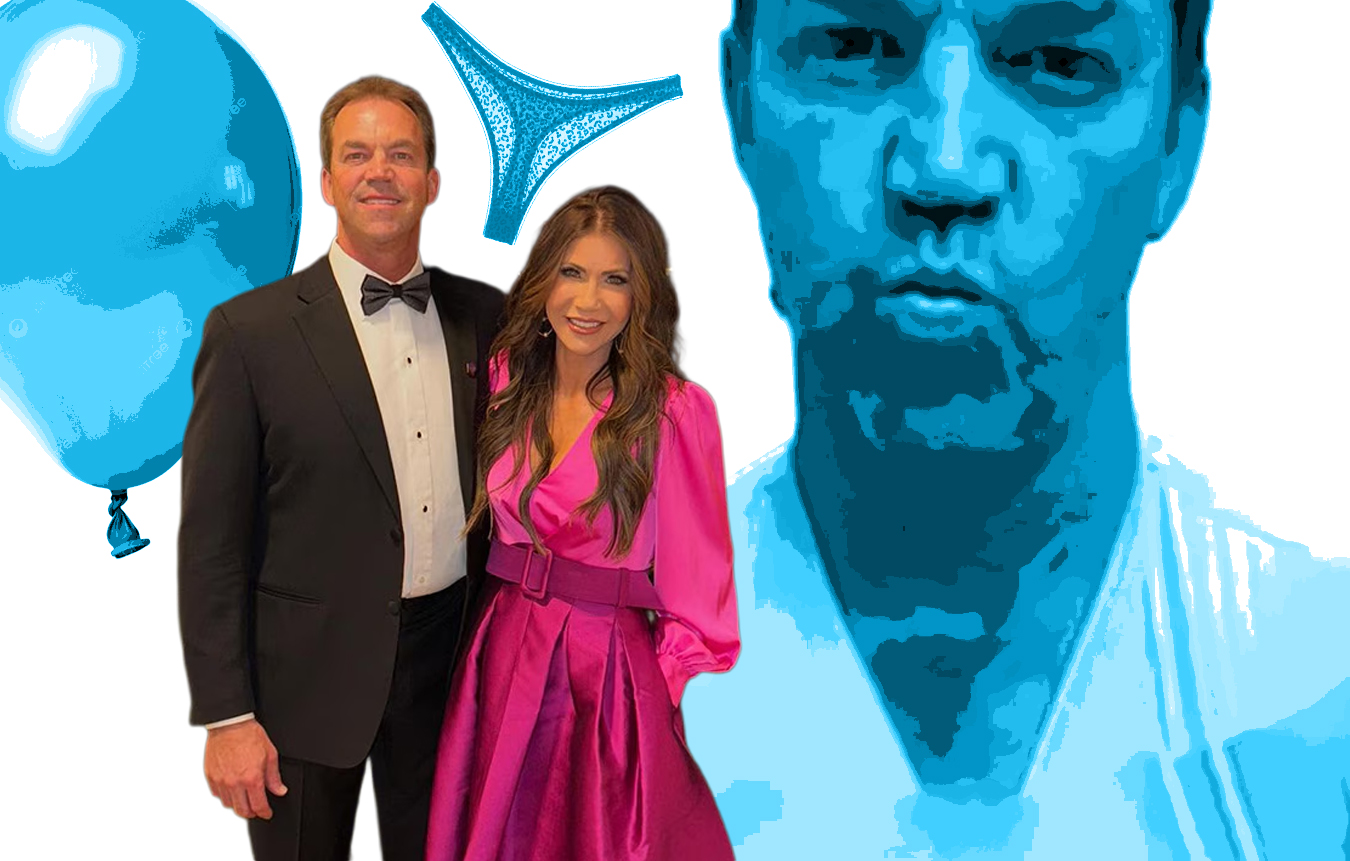
    That said, I gather most of what I do about Bryon Noem from the photos that were shared, how they were taken, and the fact that they were taken at all. Bryan Noem knows the position he’s in, given that he’s with a woman who is so closely tied to this administration. Yet he was boldly interacting with women in chat rooms and taking photos of himself in pink hot pants, balloons under his shirt, with his full face in view. These are photos that could easily be used against him and his wife, but he took and sent them out regardless. The only way an undocumented sex worker was able to figure out who he was is because used his business phone number. It’s almost intentionally sloppy. Oftentimes, these men rely on the taboo of sex work to maintain silence. However, apparently, this undocumented sex worker couldn’t stomach the fact that the husband of a woman who’s been terrorizing the immigrant community reached out to her for services. That’s what led to all of this coming out. However, this degree of boldness is something I’ve seen many times among crossdressers, and it still fascinates me. Some of these men get off on the idea of being caught. They get off on the idea of being found out, but it usually never happens. It’s the risk that it might be exciting.

    My observation is that many of these men have deep anxieties about being a man in this society and the pressure that comes with it. Oftentimes, that morphs into a humiliation fetish where the most embarrassing and erotic thing you can be is a woman or a feminine person. A lot of times, this will go hand in hand with cuckoldry that sometimes takes on a racist bend. I promise you, the guys who spend their days advocating against immigration and the idea of foreign men raping white women do indeed get off to cuck porn where a white woman cheats on her boyfriend with a man of color. It’s hard not to think about how this may relate to Kristi Noem’s affair. It’s not terribly uncommon for wives to become aware of their husband’s crossdressing habit and perhaps adjust to a mentality of “don’t ask, don’t tell,” where he’s able to continue seeing sex workers and she’s able to find a sexually capable man to fill in for him. Some people are willing to do that to maintain the pristine image of their marriage and all the benefits that come with it. Bryon Noem doesn’t seem very discreet about his activities.

    Truly, Bryon Noem’s crossdressing habit doesn’t deserve shame or hate, but there’s a lot to be gathered from understanding that he has a sexual kink that entertains the idea of him being feminized as a sexual and inherently degrading thing, and him being married to a very surgically enhanced woman who opposes access to gender affirming care. What bothers me about this isn’t so much that he crossdresses, but it’s how his politics create a situation where trans people have fewer options. Many trans women have to engage in survival sex work to support themselves. At one point, that’s what I did to survive during a time when it was legal to discriminate against transgender people. And it’s not too uncommon that those who patronize impoverished trans women are the same conservative men who vote against their rights. So in his daily life, his politics create the circumstances that put trans women on the street. Then at nighttime, he goes to sex workers so that he can get off on how shameful it is that he transgresses gender within a society that stigmatizes transgender people. And on both sides is a flex of patriarchal power. These men are often bold because they can afford to be. They live in a society that protects them, and these men are often very invested in protecting that notion. They need patriarchal rule to be the standard of culture, or else subverting it wouldn’t be so titillatingly taboo.

    It has been quite frustrating to have so much debate about whether or not Bryon Noem belongs in the queer community somehow because he is into Bimbofication and was outed for it. While it’s true that many trans women were at some point self-loathing, self-hating conservatives, there’s literally no reason at all to entertain the premise that this is the case here. What’s frustrating to me is these dudes are way more common than trans women, but they are often conflated with us by people who I don’t think are themselves able to understand that being transgender isn’t a fetish. As a kinky trans woman, I do occasionally find myself having to make it clear that my transness and my gender identity have nothing to do with each other. That I am not submissive because I’m a woman, but because I’m a submissive. That just because people fetishize me doesn’t mean I have a fetish for being myself. It’s an uphill battle in a social climate intent on misunderstanding us. Bryon Noem’s biggest crime isn’t stuffing balloons under his shirt; it’s supporting a culture that facilitates the hate and erasure of transgender people.

  • Comment Response: “ can trans people accept that they’re just a fetish?

    Comment Response: “ can trans people accept that they’re just a fetish?

    I accept that in a transphobic society, there will always be people who fetishize me. What I don’t accept is that it is impossible to be attracted to a trans person and not have a fetish.

    As a person in the BDSM community, I understand the nuance differences. There are people who fetishize the idea of a person being trans and this is often coupled with assumptions and projections about how they operate sexually. Fetishizing a trans person looks like pathologizing transness and never accepting that they exist beyond this pathology. It doesn’t look like a person finding me attractive, being interested in my body and even enjoying aspects of it that aren’t like a cis woman’s.

    Trans bodies are not a representation of a fetish, and it’s only within a transphobic framework that our bodies are understood as such. When you accept trans women as women, it becomes easier to comprehend that while cis women may not experience being fetishized for being transgender explicitly, they are often fetishized for many other reasons. It is not the existence of those fetishes that then marks them as a fetish inherently. Fetishism is something that they experience; but it is not their experience nor is it does it define them. But the difference here is that our society at least grants them their gender, and the idea that they exist beyond that.

    Because transgender people are stigmatized, they are often forced into doing sex work. For many transgender people, sex work is the way that they survive in a society where it has historically been legal to discriminate against them. The impact of that is that the vast majority of representation people have of transgender people is in some way connected to sex work and explicitly sex workers who need to fetishize themselves in order to survive. The understanding of trans people as an inherent fetish is largely connected to the fact that trans people are rarely allowed to represent themselves beyond this context.

    There have been several high profile instances of trans women being celebrated outside of the context of sex work and almost every time there has been pushback. For me, this is the perpetual cycle that needs to be broken. Because trans women are oppressed, they often end up doing sex work, and then because they’ve done sex work, they are often seen as an inherent fetish, and because they’re seen as an inherent fetish, they’re not seen as suitable for public society, and because they’re not seen as suitable for public society, most people only understand them as a fetish, and therefore oppress them. In other words, it is the oppression of trans women that gives you the understanding that transgender people only exist as a fetish, for the most part.

    However, in my life, I’ve had multiple long-term relationships. I’ve been in love more than once, and currently as a polyamorous person I have several long-term partners who very much love me and are very much proud to be seen with me. They don’t fetishize me for being transgender, in fact, they didn’t even know that I was trans when we met. What I think people in your position will always struggle to understand. Is that the reality for many transgender women moving through the world is that while plenty of people fetishize us, and plenty of people see us as through stigmatized lens, it’s actually fairly common that when men are attracted to you, and especially if you fall into a certain range of beauty, you will meet men who desire actual relationships with you. Will that be most men? Probably not, but that really doesn’t matter they are men who do and I often think that when people go out of their way to reinforce the idea that trans women only exist within the scope of a fetish, they are often fighting to maintain their access to trans, people by reinforcing and engaging in transphobia that makes trans people more accessible to them because of stigma.

  • Politically Queer, Socially Heterosexual

    I think, to some degree, I’ve always struggled with being deified. Contrary to popular belief, I didn’t throw the first brick at Stonewall. Historically, I’ve been more like the quiet wife of one of the policemen who participated in the raid. I spent my 20s trying to fade away into the background and seeing that as a sign of ultimate personal success. I suppose for that reason, I feel very odd existing in the way I do, where it seems to be disruptive of me to say that while I may be politically queer, I’m quite socially heterosexual.  

    Since my mother passed, I’ve been thinking a lot about my life path and how it compares to hers. Going through my mother’s things, I realized we had so much in common. More than I ever recognized or celebrated when she was alive. I realized that I am the version of my mother that broke away fully from a lot of the conventions that have historically been quite common within our family. Of course our experiences are quite different with me being transgender, but we are so similar in so many ways. I watched my mother, a Harvard grad, seemingly put a bit of her greatness aside in order to perform a traditional, heterosexual, Christian role. Despite my mother being more accomplished than my father, she became a woman who followed my father’s desires whether they made sense or not. I didn’t fully process this until I was older, but I think seeing her do that made me feel as if doing the same within my own relationships was some form of success.  

    Who I am in my 30s is very inspired by who I was in my 20s: a girl who desired a more traditional life where I would of course be relegated to my home and labor around the house. I used to idealize that so much that I always felt like whatever I wanted wasn’t nearly as important as whatever the man in my life currently desired. I spent most of my 20s figuring out ways to make myself seem smaller, slighter, less apparent, and less disruptive. How could I convince this man I was in love with that I’d make a good wife? Each life skill acquired, not necessarily for me. I took me a while to break through the matrix and realize that wasn’t what I really wanted, and looking at my mother when she passed, it’s hard for me not to notice how many things she wanted to do that were never done largely because she opted to have a more traditional life. I realized that I’m living a life where I’m able to at least try to pursue some of those things and so my 30s have been all about me learning to be bolder, bigger, more apparent and more straightforward.  

    Moving to Los Angeles and intentionally pursuing this path, I started being recognized more regularly as a queer person. Not usually a trans person, but quite often a sapphic person. Tragically, I am not sapphic, but a lot of people who meet me assume I am in some way. From what I’ve gathered, it’s because I am more overtly sex positive and alternative than most people, and for a lot of people, that’s an indicator of someone being not quite fully heterosexual. But I was quite different before I moved to the city.  

    A good example of how I used to dress when I was stealth in the OC.  

    Before moving to Los Angeles, I spent 6 years in Orange County in some of the more conservative parts of the county. In all my years socializing in the OC, I never met anyone who identified as queer. Maybe one girl who was trying to get me to have a threesome with her friend…but even then; I only heard about her being bisexual through someone else. I spent my 20s being very isolated in spaces where no one was openly queer, and stealth encouraged me to distance myself from anyone and everything that could be recognized as queer. I was always an outspoken pro-LGBT person; but when I say that I mean in very narrow circumstances, usually with people I knew, in private conversations, I’d offer lukewarm affirmations of gay relationships. When you’re a straight person doing that, you can easily feel like you’re being radical, but being around queer people is actually quite a different experience. It’s one thing to support something theory, it’s another when they become real, tangible people who’d likely draw attention to the unhelpful heterosexist things you internalize that aren’t directly challenged when you’re speaking of someone theoretically, but not engaging with them personally. 

    I had plenty of queer friends in college, but that was a 4 year span of my life that ultimately doesn’t really overtake the majority of my life where I knew very few queer people. In Highschool, I was probably the most openly queer person I knew. My rainbow clothes and splatter paint everything sort of gave it away. I had a more radical queer identity and during that phase of my life, I was attempting to break away from the expectations of my parents. I was trying to become my own person and, again, even that was about a 2-3 year span of my life. Yeah, it was pretty radical for me to have a mohawk and do research papers about different conceptions of gender and sexuality around the world, but ultimately, I hadn’t been in community with other queer people. I dreamed of running away to the city and going to Tiger Heat with a bunch of other LGBT people, but that never really happened. Instead, I continued to be surrounded by heterosexual people within a conservative area. As I transitioned, I very quickly went from being mildly radical within these spaces to just someone in the background who fell into the same patterns as everyone else.  

    Those patterns are my modus operandi. Being recognized as queer is odd for me because I spent most of my adult life with people assuming, correctly that I’m a straight woman and putting me into a certain category for that reason. I’m used to deferring to men and speaking to them a certain way. I’m used to people expecting me to be of use. I used to slipping into a unique harmonic tone and rhythm when speaking to other women. I’m used to shifting my tone to seem pleasant and being very concerned that I seem less than pleasant. As I’ve moved to Los Angeles and connected with queer women, sapphic or otherwise, I realize that many of them do not have these patterns. I admire it. I recognize that they are living lives where they don’t think about these things the way I do. I envy how many of the queer women I know have a boldness about them that always reinforces their boundaries and reiterates that they are not here for the pleasure or entertainment of men. I have a deep resentment for the part of me that falls into these patterns so easily. It happens sometimes when I run into other people from the OC or otherwise more conservative areas. People would often assume that I have a hard time in these spaces or moving through the world in this way, but in all reality, it’s what I’m more familiar with. It’s like we’re part of the same cult or something. 

    Because these patterns feel so central to me, I’ve often struggled with the idea of “queer” as a label that I really identified with. While I’ve changed a lot as a person, the thing that remains the same, is I feel the most radical thing about me is entirely what I say and do, and less who I am. I understand that I am a black transgender woman, I represent an extremely stigmatized and often violently attacked population, but clinging to that often feels like clinging to dogma. My race has always presented more robust hurtles and I can confidently say that when it comes to discrimination, for me, it’s mostly been racial. Even in the narrow circumstances I’ve been in where I’ve been openly trans within these more conservative spaces, there was always a sense of handwaving the trans part of me because I was otherwise assimilated into their conception of womanhood, at least socially. I may complain a lot, but in all reality, people often treat me quite well and I know it’s because I tend to move through the world with this particular suburban, heterosexual, loosely Christianized, overly polite way of presenting myself. While I used to have a lot of frustrations around DL men, that hasn’t been the case for most of the age-appropriate dating years. When people see me with my partners, our racial difference is more stigmatized than anything else. It’s hard for me not to think of “queer” as a title for those who challenge the status quo of gender and sexuality. I feel like the only area I really do that is my polyamory, honestly.  

    It feels like needless essentialization to say that I would be defined as queer solely because I happen to also be transgender. I’d probably feel differently if my work wasn’t the only area in my life where I found myself regularly speaking about being transgender. Aside from conversations with potential romantic partners, it’s not something that really comes up. I know that feels odd to say, but it’s an honest report of my life. When I was that kid with a mohawk, I was actively living in a way where I challenged assumptions of gender and sexuality, but now the assumptions made of my gender and sexuality are typically true, save for the instances where people assume I’m sapphic. As a political label, I have no problems aligning myself with queerness, but I suppose it feels odd to me to say that I myself am queer in the way many people I know who identify as queer are. I recognize the immensely complex journey I’ve gone through, but that journey feels very far away from my life today. A footnote with shoddy attribution.  

    As I said, there’s such a difference between being a sole advocate for queer people in a conservative area and being in a community with queer people. What I’ve realized recently is, on the timeline of my life, I’m realistically still just a few years into truly socializing with queer people. Many of my own assumptions of queer people based on what I’ve read, but not experienced have been turned on their head. I can now say that within my friend groups, I tend to be the token straight girl. I find queer people to be more fun, less serious and more open. That’s who I’m trying to be in my 30s. I’m trying to break away from those patterns, but it’s also quite bizarre that, because I’m a black trans woman, people tend to extend a great degree of queer street cred to me that really overstates how out and open I’ve historically been. Offline, it’s like my life has been defined by these phases of hiding myself. Initially hiding that I was trans as a child, then after coming out as trans, hiding that I was for the sake of stealth and passing. And these days, because my transness is synonymous with my work, telling people what I do for a living almost immediately outs me and that’s something I’m still getting used to.  

    I know that for people who’ve followed my blog for a while, it seems strange to say, but before the pandemic started, I had just shy over 100k subscribers on YouTube and my average video got less than 20k views. That’s not nothing, but I was definitely a far more niche creator than I currently am. I used to mostly make videos about being transgender, which meant that my content was only really relevant to the extreme minority of people searching for that kind of content online. This allowed me to be stealth while also having a YouTube channel. Long term followers of my YouTube channel will remember that I once removed all of my content and decided to go faceless for a while when I first started to date my ex. I once felt like being out as trans would ruin my entire life so even if I had a little bit of a presence online, I still went to great lengths to separate my online and offline life. That’s one of the only reasons I use the alias “Kat Blaque” online. These days, it’s pretty typical for me to be recognize when I’m out and about, but even then, I’ve discovered there’s a segment of my audience that for some reason misses each video where I mention that I’m transgender. I suppose it’s because I’ve never been a person who waves a pride flag, I’m not sure. Offline, I find that I tend to only be recognizable in liberal areas. I experience invisibility in more conservative cities, and invisibility is what I spent most of my life fighting for. It’s what I’m the most accustomed to.  

    Grabbing Margaritas in Hollywood at 33.

    I do recognize that in a cissexist world where everyone is expected to be cis and heterosexual, there are a lot of boring people who’d look at the point-by-point of my life and say, “You’re queer.” However, it feels like bending to essentialism to agree with this interpretation. People have tried to tell me who I was since the day I was born. I’m used to it. At least once a week, someone online (because it only happens online, never offline) tells me that in fact, I am actually a gay man. And it’s laughable because even when I didn’t have a binary identity, I was certainly not recognized as a man; or even boy. I’ve struggled with how I tend to be registered socially and how people register me as an idea. I suppose that’s what it’s like being on the other side of that conundrum where your reality conflicts with the working narrative people seem to have of you based on their narrow conception of others who share parts of your identity.  

    I often feel as though many people do not recognize that not all transgender women are in a constant state of transition or reaffirming their gender identity. Some of us reach a point where discussing being transgender starts to feel like needlessly drawing attention to the pimple on your forehead or the freckle on your neck. It’s a part of us, but it doesn’t define us. For many of us who transition, we reach a point of invisibility and we often have to decide to be more vocally open about who we are as a way of reminding those around us that while you may assume we are normative, we in fact are not. Some people identify so deeply with that activist spirit that it becomes a strong characteristic of their persona. I’ve met many absolutely beautiful trans women who “pass” who will tell you that they are “trannies” within the first conversation you have with them. There are some of us who move in a way where we are constantly, intentionally, drawing attention to the differences we have as a form of political action, and then there are those of us who find peace in simply allowing society to make a mostly accurate assumption of us based on our appearances. It still requires a lot of practice and strength for me to speak of myself offline openly as a transgender person. I’ve spent most of my life without that language in my vocabulary. It’s gotten easier with my public speaking, but unlike some of those trans women I’ve met who define themselves in their first few breaths, that’s just not something I have practice with. Despite being 33, I feel like if I am “queer”, I’m still a baby.  

    It’s all very possible that my feelings around this will one day change. It’s all very possible that I’ll reach a point where I feel confident in a queer identity and I don’t feel this need to constantly reaffirm that I am heterosexual, used to being assumed as such and have only moved through the world being known as such my entire adult life. Frankly, I feel quite silly inferring that vocalizing my heterosexuality is a sort of struggle, but it does frustrate me that so many people seem to assume that I have a uniquely queer perspective. I feel like there’s a layer of the world I genuinely don’t experience that many queer people do. Even the alternative subcultures I participate in are typically very heterosexual. I have no conception of some of the queerer sides of many of the communities I’m part of. Much of what drives my curiosity of queer culture relates to that. A whole layer of culture that feels distinctly separated from what I currently know. I’ve read more than I’ve experienced. Advocated for more than broken bread with. I catch myself thinking ignorant thoughts and drawing heterosexist comparisons and being disappointed in myself for being ignorant despite what I’ve professed.  

    As I get older, I recognize more and more that I have so much capacity for growth. That with each year, I learn something new about myself that shifts me in a more genuine direction. Maybe my feelings around this will change one day, but for now it seems pretty truthful of me to say that while I may be politically queer, I’m still very socially heterosexual. Maybe that’ll change one day. Maybe it won’t.