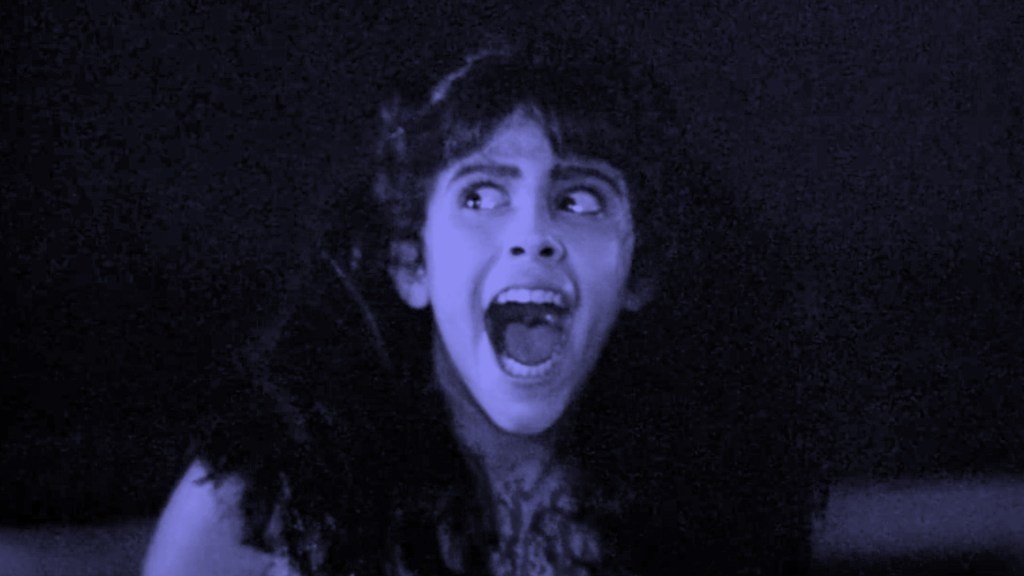
Robert Hiltzik’s 1983 slasher film Sleepaway Camp, has been the source of debate since its release. If you haven’t seen the film, you can watch my review below where I quickly summarize the plot of the film and share my thoughts on the discourse around whether or not the film is “transphobic”.
In the film, Jon Baker takes his two children, Angela and Peter to a lake where a gruesome accident ultimately ends up killing him and one of his children. 8 years later, we discover that Angela is the child that survived, and she’s gone away to live with her Aunt Martha Thomas. Aunt Martha has a child named Ricky who’s since become incredibly protective of his cousin, Angela. Together, they go to a sleep-away camp named Camp Arowak, which also happens to be right next to that same lake where Angela’s father was killed. Angela is clearly very traumatized, and she remains mostly quiet and withdrawn through her time at camp, which leads to her being mercilessly bullied. While at camp, a series of gruesome murders occur, and we don’t find out who our murderer is until the final frame of the film. The murder turns out to be Angela; who in fact isn’t even Angela at all, but Peter. See, Aunt Martha had decided to raise Peter as Angela simply because she’d always wanted a girl. the only way we know that Angela is in fact Peter is the final frame of the film that shows her male genitalia as she screams animalistically at the camp counselors who discover her.

In the Sleepaway Camp fandom there’s a lot of debate about whether or not Angela is truly transgender because of the fact that she was indeed forced to be a girl by her demented Aunt. Because Robert Hiltzik worked only on the first film, some debate whether or not the other films are canon. In the second film, Angela is indeed confirmed as canonically transgender because she ends up having bottom surgery. However, even with that information, there are still people who debate if we can consider Angela to be truly transgender in the sense most transgender women are and when this film is criticized as transphobic, there’s a debate about whether or not it can be considered such if the person being referenced isn’t transgender at all. In this post, I wanted to expand my thoughts about the transphobia of the film and why it doesn’t really matter if a character is “truly” transgender for transphobia to be expressed.
Before we launch into this conversation, I think it’s truly important to establish what transphobia actually is; at least to me. I think it’s important to define because frequently I find that people don’t have a great understanding of the actual impact of isms and that’s why they often end up falling for the idea that if something doesn’t exactly fit into these narrow parameters it can’t be described as ism.
As I’ve spoken about before, I am someone who has not lived the easiest of lives. Part of my survival in most spaces I’ve been in has been not allowing isms to get me down. When you criticize isms, people often conflate that with being personally offended or hurt and I tend to see that as rather reductive. It’s reductive because it doesn’t actually matter whether or not it hurts me, these things are worth criticizing because they hurt others. There’s a long list of slurs and insults that relate to my immutable qualities that you could throw at me that would not personally offend me. My heart doesn’t pause or jump when a white person calls me the n word because I’m used to it and it’s kind of an easy and uncreative insult. It doesn’t matter that I’m not personally offended, I’m still able to access the history of harm and the narratives established by that specific type of dehumanization. And that’s what a lot of this is. We find ways to dehumanize each other for immutable qualities and that process validates a set of ideas and justifies some incredibly dangerous actions. So, it annoys me when people’s perceptions of why I’m speaking about things that harm others is always that I am offended or more sensitive than most; because in reality, it takes a lot of bravery to stand against people who are attempting to harm you. I personally think the person who stands up to that white person slurring them is a lot braver than the person who stomachs it and lets it wash off their back. I’m talking about this because I know these ideas have a negative impact on a lot of people. While Sleepaway Camp is a silly, campy and seemingly harmless film for perhaps the majority of people who’ve seen it, the film also promotes some very hurtful tropes and that’s what we’re discussing here today.
I’ve mentioned this a few times, but some of my first exposure to transgender people was through the Jerry Springer show. On this show, a very standard sort of scenario would play out time and time again. A beautiful woman brings on what is usually a fairly average looking man to reveal her big secret; she’s actually a man! And across the country and even the world, this became the common understanding of who transgender women were. Men who cross-dress as women in order to trick heterosexual men into their beds. As I got a bit older and started knowing more people, I’d discover something very interesting about quite a few of the people who appeared on that show: most of them were not transgender women at all, and many of the people on that show who were presented as trans women were discovered by casting agencies through websites like backpage and craigslist, where trans and cross-dressed sex workers once were about to sell their affection. They weren’t actually in relationships where they were dishonest about who they were. They were paired up with men they often didn’t know in order to sell a story. To sell an idea. Some of the couples were real, yes, but for a lot of people who appeared, it was simply about being on TV. Did it particularly matter that many of these people weren’t trans women in a true sense? Not at all. Our society saw these fake scenarios, took them at face value and ran with it.
When I have discussions with people about things like this and they start to debate about whether or not something can be called transphobic if the person in the thing being referenced isn’t actually transgender, it kind of makes me giggle. I giggle because it’s optimistic to believe that our society is so understanding of transgender people that they are able to tell the difference. What many may not understand is that whether you’re a fully passable post op trans woman with 30 years of hormones or you’re a boy in a wig, those who are transphobic or have been informed by transphobia do indeed see you as virtually the same. There’s a minority of informed people who feel differently, but to many people, you are the gender you were assigned at birth, always; no matter what. That’s the harsh reality so imagining that Hiltzik sat down and wrote Sleepaway Camp with an informed mind is adorably optimistic.

Sleepaway Camp’s big reveal made me think of how we’re currently discussing gender affirming care for minors. Gender affirming care is very commonly misunderstood. If you ask a republican, they’ll tell you about sex change operations for kids and boob jobs for toddlers. Despite the fact that transgender adults have to jump through a lot of hoops to have those surgeries, the prevailing idea is that doctors are mutilating children, at the behest of their abusive parents who are forcing an LGBT lifestyle on them. In reality, gender affirming care for minors looks like a parent taking their child to a therapist who will speak to them about gender dysphoria to sort out if that’s really what they’re experiencing. If you’re rich and live in one of the few areas where this care is accessible to you, you may be able to start puberty blockers around the age 13 or 14. Puberty blockers have been used on children for a very long time and they are indeed reversible; but they aren’t suggested for more than 4 years because that’s when adverse effects occur. Puberty blockers are not hormones and do not feminize or masculinize your body. They simply allow you to, as an adult, not have to do the work of undoing a puberty (which is the main purpose of most transgender plastic surgery) before starting on the path of hrt, which will allow your body to develop in a way that more effectively treats gender dysphoria. I didn’t transition medically quite that young, but because I did transition fairly young, I can attest to this being the case. At 33, I barely experienced gender dysphoria because I was able to take hormones early enough for my body to develop how I wanted it to develop. In most other circumstances, wanting your child to develop in a way that makes them feel at ease within their body is seen as a good thing. However, when it comes to transgender children, many see it as inherently abusive. And that very common misunderstanding is why I’m not exactly keen on pretending as though someone writing about a character like this is starting from the premise that this character isn’t actually trans. While I agree that Aunt Martha forcing Peter to live as Angela is abusive, I know that the only real distinction that shifts this is Angela’s choice.
What we see in the film is Aunt Martha saying that she’s always wanted a little girl. What we don’t necessarily see in the film, though it’s heavily implied, is Peter disagreeing with this. Canonically, I think it’s safe to say that Aunt Martha preyed on a traumatized child, but is it entirely impossible that Peter was always transgender? Is it entirely impossible that Aunt Martha was actually just really affirming, and that scene was her simply embracing her new daughter’s identity? What if on top of being transgender, she’s also just a sadistic murderer? What is the purpose of meshing the reveal of her genitalia with the violence she’s exerting if not to insinuate that bodies like hers are violent, dangerous and mentally unstable?
The film presents Angela being actually a boy as the main motivation for why she did what she did. One of my commenters even left a lovely comment saying:
“It makes sense that Angela was a boy because she maintained her male pattern of violence”
See, this idea that transgender women maintain a “male pattern of violence” is indeed an argument made against actual transgender women. When people debate about which bathroom I should use and say I shouldn’t use the women’s because I may attack a woman in the restroom, that is the idea they’re citing. Me being “actually” transgender doesn’t actually matter. It doesn’t matter how many years I’ve been on hormones, how “passable” I may be, or how many surgeries I’ve had. The idea is that regardless of all that, I am a man and men are violent, especially when they think they’re women and allow others to believe it.

And that is the entire premise of Sleepaway Camp. Everyone thought she was a cis girl with a vagina, but it turns out she had the wrong parts. And we only see that wrong part the exact moment we learn she’s a murderer. And whose head is she holding? Her lover, a presumably heterosexual boy who was misled by Angela. How unfair to him that after days of pressing her, he didn’t get what he wanted and was instead misled? While I choose to believe she ultimately killed Paul because he kissed Judy and she really liked him, a lot of fans choose to believe that she murdered him because he couldn’t accept that she was transgender. We have absolutely no reason to believe that; but it’s the conclusion people jump to. Why? Because that’s the standard understanding of how trans women function in our society. That we are incredibly touchy about being rejected and get off on tricking men. Never mind the many men in my life who, in that moment become more sexually interested, not less. Never mind how men will often lie about not knowing to fulfill their trap fantasy. Never mind that there are plenty of people who are attracted to trans women. The assumption made is he had a poor reaction and she reacted violently. Where do they get that from? Probably a lot of people who aren’t “actually” trans.
When I describe something as transphobic, it’s generally because it forwards an untruthful narrative about transgender people. I don’t have to trick men into my bedroom. Parents supporting their trans children are trying to keep them alive. Transgender women are far more likely to be the victims of violence than they are to exert it. And yet, all of these narratives thrive largely because of…. drum roll… transphobia. Transphobia that makes it so that transgender people very rarely speak for themselves and are instead spoken about and theorized about. We can document our entire lives, make documentaries about who we are, post easy to understand resources trying to explain why these ideas are wrong, but thes misunderstandings will still be the most prevalent. And that’s why I find it productive to call it out; because more media pushing that narrative does indeed harm us. Even if the people being discussed aren’t “actually” transgender.
I think Sleepaway Camp is a relic of its time. I think that viewing it through a modern lens isn’t necessarily productive. But I do think it’s important to take it for what it is and accept that, yeah, maybe some of the stuff you love can sometimes still be problematic. Robert Hiltzik made a film about how a child’s gay father traumatized her by simply having a partner. Before she even got to the aunt, that was presented as her first source of trauma: having a gay dad. It’s not hard to see how that’s kind of homophobic. I don’t think that makes you homophobic for enjoying the film. Plenty of LGBT people absolutely love this series. It’s really not that black and white. I think we’re capable of saying the premise of a film is transphobic and also saying it’s a fun slasher film.


 Blaque In The City
Leave a comment